
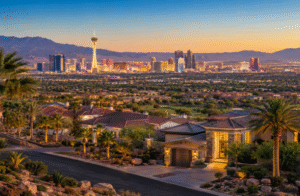
Las Vegas and Henderson are not crashing, but they are no longer seller-controlled markets. The market has shifted into a buyer-leverage, price-sensitive, concession-driven environment. Homes are still selling, but buyers are slower, more selective, more payment-focused, and much more willing to cancel if the numbers, inspection, appraisal, or total monthly cost do not work.
Public data is very strong on prices, sales, inventory, days on market, and national mortgage application trends. Public data is weaker on local loan applications, local refinance applications, reverse mortgage applications, and exact seller concession dollar averages, because those typically come from lender pipelines, MLS private fields, builder reports, or paid data platforms.
1. Market Snapshot: Where Las Vegas Stands Right Now
As of March 2026, the Southern Nevada resale market is showing three clear trends:
Inventory is up.
By the end of March, Las Vegas REALTORS reported 6,456 single-family homes listed without offers, up 19.2% year over year. Condo/townhome inventory without offers was 2,568 units, up 16.5% year over year.
Prices are slightly softer year over year, but still near historic highs.
The median price for existing single-family homes sold through the Southern Nevada MLS in March was $480,000, down 1.0% from March 2025, and below the record $488,995 set in November 2025. Condos/townhomes were at $295,000, down 3.8% year over year and below the October 2024 record of $315,000.
Sales improved in March, but the multi-year trend is still slower.
LVR reported 2,806 existing local homes, condos, and townhomes sold in March 2026. Single-family sales were up 6.8% year over year, while condos/townhomes were down 9.1% year over year. LVR also notes 2025 was the lowest annual sales year since 2007, with sales generally declining since the 2021 peak of 50,010 total properties sold.
2. Las Vegas City vs. Henderson
Las Vegas
Redfin’s city-level March 2026 data shows Las Vegas homes sold for a median price of $448,000, down 0.44% year over year. Homes sold in about 60 days, compared with 51 days last year. March closed sales were essentially flat at 858 homes, compared with 859 one year earlier.
That tells us Las Vegas proper is behaving like a flat-to-slightly-soft market, not a depreciation spiral. The biggest change is not price collapse; it is speed and leverage. Buyers have more time, more choices, and more negotiating room.
Henderson
Henderson’s March 2026 median sale price was $499,990, essentially flat year over year. Homes sold in about 62 days, compared with 52 days last year. Sales were stronger than Las Vegas proper, with 601 homes sold, up 7.1% year over year.
Henderson is holding value better at the headline level, but it is still experiencing the same slowdown in velocity. The market is not dead. It is just much more selective.
3. Last 90 Days: Sales Volume
Using the public LVR data available for January, February, and March:
| Month | Existing Local Sales |
|---|---|
| January 2026 | 1,445 single-family + 380 condo/townhome = 1,825 total |
| February 2026 | 2,088 total existing homes, condos, townhomes |
| March 2026 | 2,806 total existing homes, condos, townhomes |
| Approx. 90-day total | 6,719 closed resales |
January’s report showed 1,445 single-family units sold and 380 condo/townhouse units sold, with single-family sales down 8.4% year over year and condo/townhome sales down 8.0% year over year. February totaled 2,088 existing local homes, condos, and townhomes, with sales down year over year, while March rebounded to 2,806 total sales.
Interpretation: January was weak, February was still soft, and March improved. That is seasonal, but it also shows buyers are present when rates stabilize and inventory gives them options.
4. Days on Market: The Market Is Slower
This is one of the most important metrics right now.
In Las Vegas city, homes sold in about 60 days in March 2026 versus 51 days a year earlier. In Henderson, homes sold in about 62 days versus 52 days a year earlier.
LVR’s broader Southern Nevada data also shows fewer homes selling quickly. In February, only 64.2% of existing local homes sold within 60 days, down from 71.0% one year earlier. In March, 71.5% of homes sold within 60 days, still below 76.0% one year earlier.
What this means:
A clean, well-priced home can still sell. But overpriced homes, homes needing repairs, homes with weak presentation, and homes competing with builder incentives are sitting longer. Sellers cannot price like it is 2021 or 2022.
5. Average / Median Sale Price: Last Year vs. This Year
Southern Nevada Single-Family
March 2026 median single-family resale price: $480,000
March 2025 comparison: down 1.0% year over year
Record high: $488,995 in November 2025
January 2026 median single-family resale price: $470,000, down 3.1% year over year.
February 2026 median single-family resale price: $481,995, down 0.6% year over year.
March 2026 median single-family resale price: $480,000, down 1.0% year over year.
Conclusion: The 2026 resale market is mostly flat to slightly down versus 2025, depending on the month and property type.
Condos / Townhomes
Condos and townhomes are softer than single-family homes. February condo/townhome median price was $285,000, down 5.9% year over year. March was $295,000, down 3.8% year over year.
Conclusion: Condos are more vulnerable because of HOA dues, insurance pressure, financing restrictions, investor concentration, litigation/budget issues, and buyer affordability.
6. What Has the Market Done Over the Last Two Years?
The best description is: sideways with volatility.
From 2024 to 2026, the market has not behaved like a traditional crash. Instead, it has moved through:
- 2024: affordability pressure, but prices remained supported by limited supply.
- 2025: record-high prices in certain months, but declining transaction volume.
- 2026: more inventory, longer days on market, more seller concessions, slightly lower year-over-year prices.
LVR reported that 2025 had fewer sales than 2024 and was the lowest annual sales total since 2007. Sales have generally declined since the 2021 peak of 50,010 total properties sold.
My read: Las Vegas has been in a transaction recession, not a value collapse. Homeowners have equity, distressed sales are low, and many sellers do not have to sell. That is why prices have not fallen dramatically even though demand is weaker.
7. Contracts and Cancellations
This is one of the biggest red flags for agents and lenders.
A Realtor.com-cited report showed the Las Vegas-Henderson-North Las Vegas metro had a 10.1% contract cancellation rate, one of the highest among major metros, compared with a national contract fallout rate around 7.1%.
Why deals are falling apart:
Buyers have more options, so they are less emotionally locked into one property. They are using inspections, appraisals, rate movement, HOA reviews, insurance quotes, and payment shock as reasons to renegotiate or cancel. In condos/high-rises, this is even more sensitive because HOA dues, reserves, insurance, litigation, investor concentration, and condo questionnaire issues can change the loan structure quickly.
Practical meaning:
A pre-approval is not enough anymore. Buyers need a full payment strategy, concession strategy, property-type review, and lender review before they go hard on a contract.
8. Seller Concessions
There is not one perfect public MLS number showing the exact average Las Vegas seller concession dollar amount. But the direction is clear: concessions are back.
A local April 2026 market report stated that roughly one in three closed transactions in early 2026 included some form of seller concession, most commonly closing cost help or rate buydowns. Nationally, Redfin reported that 44.4% of U.S. home sale transactions included seller concessions in Q1 2025, showing that concessions have become a major part of the current buyer-leverage market.
For Nevada, buyer closing costs are commonly estimated around 2% to 5% of the purchase price, while one 2026 Nevada estimate puts average closing costs around 2.94% of the home’s purchase price.
What I would use in the field right now:
For a $480,000 Las Vegas home, a practical seller-credit conversation is often in the $7,500 to $15,000 range, and in some cases higher, depending on days on market, builder competition, property condition, and whether the buyer is using the credit for closing costs, temporary buydown, permanent buydown, or repairs.
9. Mortgage Applications: Purchases and Refinances
Local Las Vegas application counts are not usually public unless pulled from private lender, MMI, HMDA lagged data, Optimal Blue, or lock-volume platforms. The best current public proxy is MBA national weekly application data.
For the week ending April 24, 2026, MBA reported total mortgage applications were down 1.6% week over week. Refinance applications fell 4%, but were still 51% higher than the same week one year earlier. Purchase applications rose 1% week over week and were 21% higher year over year.
MBA’s reported average 30-year fixed conforming rate was 6.37% for the week ending April 24, up from 6.35% the prior week.
Fannie Mae’s April 2026 forecast projected the 30-year fixed mortgage rate averaging around 6.2% in 2026 and 6.1% in 2027. It also projected single-family mortgage originations rising from $1.960 trillion in 2025 to $2.342 trillion in 2026, with purchase originations increasing from $1.387 trillion to $1.432 trillion, and refinance originations increasing from $573 billion to $911 billion.
Interpretation for Las Vegas:
Purchase applications should improve when rates stabilize near low-6% levels. Refinance activity will be very rate-sensitive. A move toward the high-5s would create a much larger refi wave, especially for 2023–2025 borrowers, FHA borrowers, VA borrowers, and high-interest debt consolidation candidates.
10. Reverse Mortgages
Reverse mortgage demand should be watched closely in Las Vegas because the market has a large retiree population, substantial homeowner equity, and many borrowers who are payment-stressed but equity-rich.
National HECM data shows volume is not exploding. Reverse Market Insight reported April 2026 HECM endorsements declined 1.4% to 2,088 loans, while March had increased 16.3% to 2,117 loans.
HUD’s 2026 HECM lending limit is $1,249,125, which matters for higher-value Las Vegas and Henderson homes because more property value can be considered in the reverse mortgage calculation, although proceeds still depend on age, rates, and principal limit factors.
Interpretation:
Reverse mortgages are not yet mainstream compared with forward refinances, HELOCs, and cash-out refinances, but in Las Vegas they should be a major conversation for homeowners 62+ who are equity-rich, income-limited, and trying to eliminate mortgage payments or improve cash flow.
11. Where the Market Is Heading Over the Next 90 Days
My 90-day prediction for Las Vegas / Henderson
1. Inventory will likely keep rising into summer.
Spring and early summer usually bring more listings. Since inventory was already up nearly 20% year over year for single-family homes in March, buyers should continue to have more choices.
2. Prices should remain mostly flat, with soft spots.
The most likely path is not a major crash. The likely path is flat to slightly down in overpriced segments, condos, homes needing work, and listings competing with aggressive builder incentives. Properly priced homes in desirable areas should hold up.
3. Days on market will remain elevated.
Expect many homes to sit 45–75+ days, with price reductions becoming more common for sellers who overshoot the market.
4. Seller concessions will remain normal.
Concessions are now part of the deal structure. Buyers will continue asking for closing cost credits, rate buydowns, repair credits, and HOA/payment offsets.
5. Purchase applications should improve if rates stay stable.
MBA’s national purchase index is already showing year-over-year improvement, but Las Vegas buyers remain payment-sensitive.
6. Refinance activity depends almost entirely on rates.
If rates stay in the low-to-mid 6s, refis will be selective: VA IRRRLs, FHA streamlines, debt consolidation, divorce buyouts, cash-out needs, and high-rate 2023–2025 borrowers. If rates move into the high-5s, refinance volume could accelerate quickly.
12. Best Strategic Read for Agents, Buyers, Sellers, and Lenders
For buyers
This is a better buyer market than we had during the frenzy. Buyers can negotiate price, closing costs, buydowns, repairs, and sometimes appliances or HOA-related credits. The mistake is waiting only for a lower rate and ignoring the leverage available today.
For sellers
Price correctly from day one. The market is punishing stale listings. A seller who lists too high, refuses concessions, and ignores condition will likely sit longer and eventually chase the market down.
For real estate agents
Agents need to stop selling “the dream” only and start selling the math. Payment, concessions, buydown structure, closing cost reduction, and refinance strategy are what convert buyers right now.
For lenders
The opportunity is in strategy, not just rate quoting. The winning lender in this market is the one who can structure FHA, VA, conventional, jumbo, DSCR, bank statement, condo/high-rise, reverse, and cash-out/debt consolidation options clearly.
Bottom Line
Las Vegas and Henderson are in a buyer-opportunity market, not a crash market.
Prices are mostly flat to slightly down year over year. Inventory is up. Days on market are longer. Contract cancellations are elevated. Seller concessions are back. Buyers have more leverage than they have had in years, but affordability is still tight because rates remain elevated.
The next 90 days should favor buyers who are fully underwritten, payment-aware, and strategic. Sellers can still win, but only if they price correctly and understand that concessions are now part of the market. For lenders and agents, this is the kind of market where education, structure, and speed will create business.